Unrivalled Connectivity
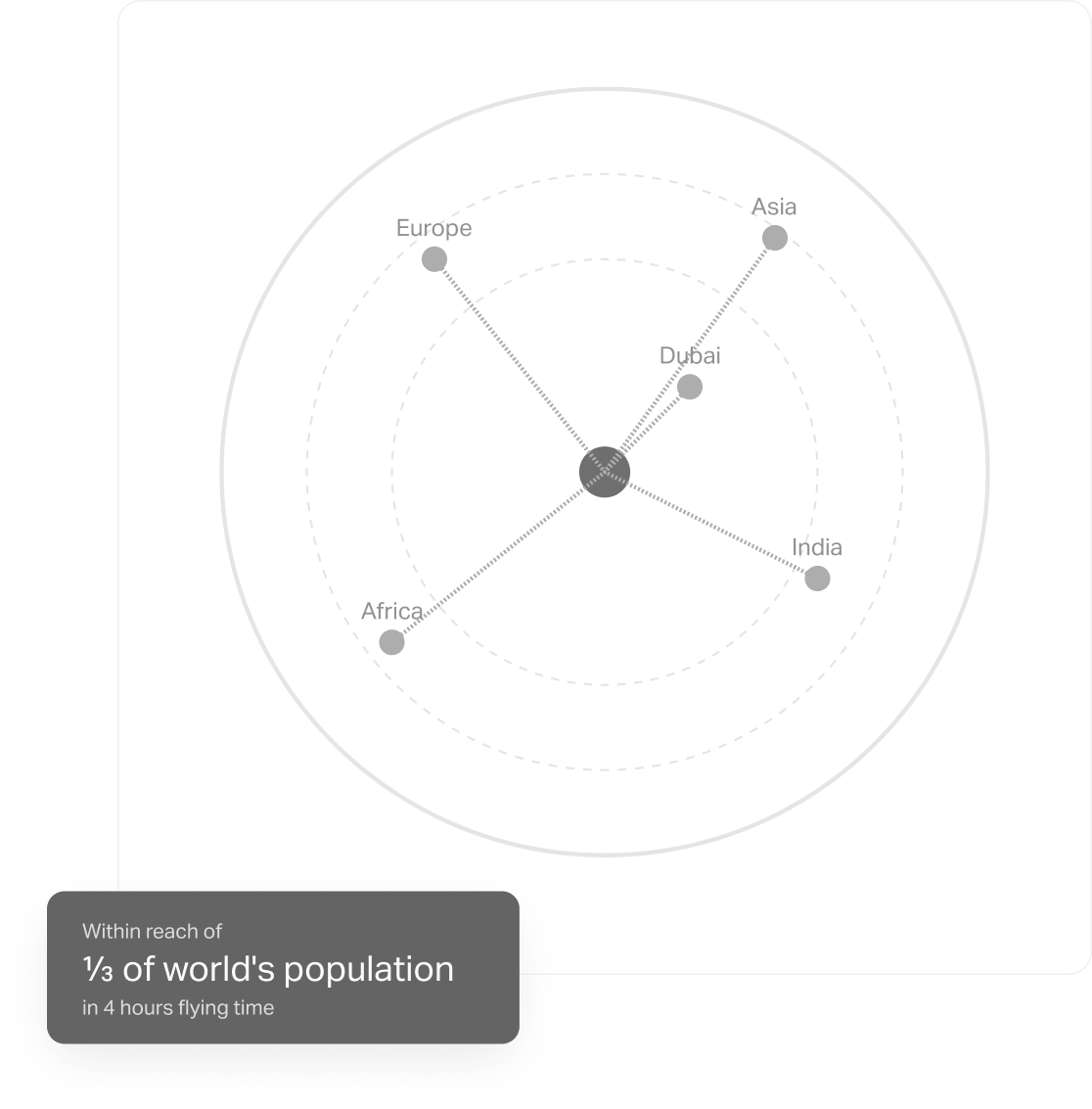
Ras Al Khaimah lies at the crossroads of Asia, Europe and Africa – within four hours flying time of one-third of the world’s population – and just an hour’s drive from Dubai, home to DXB, the world’s busiest international airport.
Proximity to Dubai
.png?width=40&height=40&name=SVG%20(6).png)
.png?width=40&height=40&name=SVG%20(7).png)
Proximity to Dubai
Ras Al Khaimah is roughly an hour’s drive from Dubai, via modern, multi-lane motorways, making travel between the two emirates fast and efficient. This connection allows residents to enjoy Ras Al Khaimah’s relaxed lifestyle while remaining close to Dubai’s business districts, leisure and lifestyle attractions.
For companies, the proximity provides a strategic advantage: the ability to maintain a lower operating-cost base in Ras Al Khaimah while staying within easy reach of the UAE’s largest business, travel and tourism hub.
RAK Airport
.png?width=40&height=40&name=SVG%20(8).png)
.png?width=40&height=40&name=SVG%20(9).png)
.png?width=40&height=40&name=SVG%20(10).png)
Air Connectivity
Ras Al Khaimah International Airport continues to expand its role as a key regional gateway. In addition to its growing network of direct routes across the Middle East, India, Central Asia and Europe, the airport is developing a new VVIP terminal and private aviation facility with Falcon Executive Aviation.
Set for completion in 2027 and designed to LEED Gold standards, the project includes a 1,500 sqm terminal, an 8,000 sqm hangar and dedicated apron space capable of accommodating the latest generation of corporate jets. It will also feature a Royal Lounge, private salons and aircraft-side access for travellers.
Ras Al Khaimah International Airport is centrally located around 30 minutes from Marjan’s masterplanned communities – while Dubai International Airport (DXB) provides additional global connectivity within a short drive. Together, they give residents, visitors and businesses flexible access to almost 300 regional and
international destinations.
Roads


Roads Infrastructure
Ras Al Khaimah is connected by a modern motorway network linking the emirate to all major UAE cities. The E311, E611 and E18 provide rapid access to Dubai, Sharjah, Fujairah and Umm Al Quwain. A US$200 million expansion of the E311 is currently underway and will reduce travel times to Dubai by an estimated 45%.
Within Ras Al Khaimah, ongoing upgrades to internal roads continue to improve traffic flow and ease movement between communities and business districts. For businesses, this infrastructure ensures efficient transport and reliable logistics across the UAE.
Ports


Ports Facilities
Ras Al Khaimah is a major maritime hub, supported by a network of ports that handle more than 100 million tonnes of cargo each year. Saqr Port, the largest bulk cargo port in the Middle East and Africa, sits at the centre of this network, alongside RAK Maritime City, Ras Al Khaimah Port and Al Jazeera Port. Together, they provide bulk handling, project cargo services, warehousing, cold storage and ship repair facilities.
The next phase of this development is Saqr 2.0, a US$1 billion expansion designed to meet future demand and unlock new markets. The project will create a deep-water, multi-purpose port capable of accommodating capesize vessels and a wider range of cargo types. It will also create around 5 million sqm of free-zone land with direct quayside access.
The first phase, due to begin operations in 2027, will add 6–10 new berths and roughly 50 million tonnes of additional annual handling capacity. Later phases, running into the 2030s, will expand the port and free-zone further, with long-term potential to reach 12–14 million square metres of developable land.
These upgrades will strengthen Ras Al Khaimah’s standing along one of the world’s busiest shipping routes near the Strait of Hormuz. They also support the Emirate’s economic diversification efforts by enabling new industries, improving port-land connectivity and creating opportunities in sectors such as renewable energy logistics, fabrication, ship repair and future fuels.